


 By neha - June 08, 2026
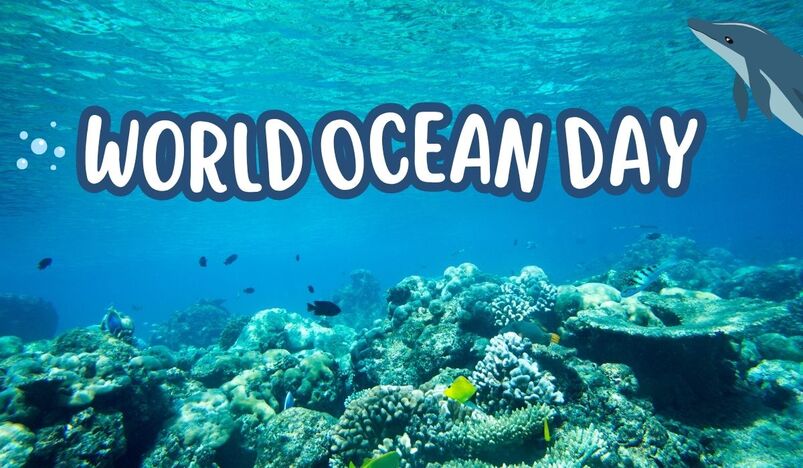
The ocean covers 71% of Earth's surface and drives every living system on this planet. One day a year, the world focuses on protecting it.
- 71% of Earth covered by ocean
- 50%+ of our oxygen comes from the sea
- 3 billion people rely on seafood as protein
- 8M of plastic enter oceans annually
- 90% of global trade moves by sea
Most of us interact with the ocean only during vacations — a beach holiday, a seafood dinner, a documentary on television. But the truth is, the ocean is involved in almost every breath you take, every bite you eat, and every weather system that shapes your day. World Ocean Day, observed each year on June 8, exists to close that gap between how disconnected we feel from the sea and how profoundly dependent on it we actually are.
What Is World Ocean Day?
World Ocean Day is an annual global observance dedicated to celebrating the world's ocean, raising awareness about the critical role it plays in sustaining life, and mobilizing people and organizations to take action for its protection.
It is not a public holiday in most countries, but it functions as a focal point — a day when schools, governments, NGOs, marine scientists, coastal communities, and ordinary citizens come together through events, campaigns, beach cleanups, and policy conversations.
Key Fact
World Ocean Day was officially recognized by the United Nations General Assembly in 2008, though it had been celebrated informally since 1992. The UN designated the Ocean Affairs and the Law of the Sea division to coordinate global observance.
A Brief History: How It Started
The concept of World Ocean Day was first proposed at the Earth Summit in Rio de Janeiro in 1992 — the same summit that produced the Convention on Biological Diversity and set the foundation for modern climate negotiations. The proposal came from Canada's International Centre for Ocean Development and the Ocean Institute of Canada.
- 1992: Canada proposes World Ocean Day at the Earth Summit in Rio de Janeiro.
- 1992–2008: Observed informally by ocean organizations and coastal communities worldwide without formal UN backing.
- 2008: UN General Assembly officially designates June 8 as World Ocean Day through Resolution 63/111.
- 2009: First officially recognized World Ocean Day observed globally under UN coordination.
- 2023–present: The day now anchors the UN's "Ocean Decade" (2021–2030), a global science-for-action campaign for ocean health.
World Ocean Day 2025: The Theme
The 2025 theme is "Oceans: Action for a Sustainable Future."It centers on accelerating the science, policy, and community action needed to protect and restore ocean ecosystems before the damage becomes irreversible. It aligns closely with the goals of the UN Ocean Decade, which aims to deliver transformational ocean science to support sustainable development.This is a direct call for urgency — not awareness alone, but measurable, accountable action.
Why the Ocean Matters: Beyond the Surface
When people think about why oceans are important, they often stop at "it's beautiful" or "fish live there." The actual scale of what the ocean does for every living thing on Earth is considerably more staggering.
- Oxygen production: More than half of the world's oxygen is produced by marine phytoplankton — microscopic organisms drifting in the upper layers of seawater. Every second breath you take was, in effect, produced by the ocean. The Amazon rainforest generates roughly 6% of Earth's oxygen. The ocean handles the majority.
- Climate regulation: The ocean absorbs about 25% of all carbon dioxide emitted by human activities each year and has absorbed more than 90% of the excess heat generated by greenhouse gas emissions since industrialization. Without it, global temperatures would already be catastrophically higher.
- Food security: Approximately 3 billion people depend on seafood as their primary source of protein. Marine fisheries and aquaculture support the livelihoods of more than 600 million people worldwide, mostly in developing countries.
- Economic value: The ocean economy — fisheries, shipping, tourism, coastal infrastructure, marine biotechnology — is estimated to be worth over $3 trillion per year. Around 90% of all global trade, by volume, moves across the sea.
The Real Threats Facing Our Oceans Right Now
Ocean warming and acidification. Ocean surface temperatures have hit record highs for over a year. As oceans warm, coral bleaches, fish migrate, and weather systems intensify. CO₂ absorption is making seawater 30% more acidic than pre-industrial levels, dissolving the shells and skeletons of marine life.
- Plastic pollution: An estimated 8 to 10 million metric tons of plastic enter the ocean every year. Microplastics have been found in the deepest ocean trenches, in Arctic ice cores, and in human blood. They enter the food chain at the base and move upward.
- Overfishing: The FAO estimates that over one-third of global fish stocks are harvested at biologically unsustainable levels. Industrial fishing removes massive quantities of marine life far faster than populations can recover.
- Coral reef destruction: Coral reefs cover less than 1% of the ocean floor but support 25% of all marine species. Warming waters, acidification, and coastal pollution have killed half of the world's coral reefs in the last 30 years. The Great Barrier Reef experienced its sixth mass bleaching event in 2024.
- Noise and chemical pollution: Industrial shipping, sonar, and seismic surveys create underwater noise that disrupts whale navigation and communication over thousands of kilometers. Chemical runoff from agriculture creates massive dead zones — the Gulf of Mexico dead zone covers roughly 6,000 square miles each summer.
- Sea level rise: The ocean has risen roughly 20 cm since 1900, with the rate accelerating sharply in recent decades. IPCC projections put sea level rise at 0.3 to 1 meter by 2100 under current trajectories.
By 2050, scientists estimate there could be more plastic in the ocean by weight than fish — if current production and disposal trends continue.
What Happens on World Ocean Day?
At the international level, the United Nations hosts a major event in New York featuring marine scientists, heads of state, youth activists, and civil society organizations.
Around the world, activities typically include beach and coastal cleanups organized by groups like Ocean Conservancy and Surfrider Foundation; school and university programs including marine science fairs and documentary screenings; government policy announcements such as new marine protected area designations and fishing regulation reforms; science communication events at research institutions and aquariums; and global social media campaigns connecting coastal communities with landlocked advocates.
How to Observe World Ocean Day: 8 Actions That Actually Help
Awareness is the beginning, not the end. Here are actions that have measurable impact — whether you live by the coast or a thousand miles from the nearest shore.
- Audit your single-use plastic use for one week: Don't try to eliminate everything at once. Track what you use for seven days — bags, bottles, packaging — and replace the top three with reusable alternatives. That behavioral change persists long after June 8.
- Choose seafood from sustainable sources: Use resources like the Monterey Bay Aquarium Seafood Watch or the Marine Stewardship Council (MSC) certification to identify sustainably harvested fish. Consumer demand genuinely shapes what fisheries do.
- Join or organize a beach or waterway cleanup: Ocean Conservancy's International Coastal Cleanup runs on and around June 8 every year. You don't need to live near the ocean — river and lake cleanups prevent plastic from reaching the sea through waterways.
- Support organizations working on marine policy: Groups like Oceana, the Ocean Foundation, and WWF's marine programme need sustained financial support — not just viral moments. A small recurring donation funds marine protected area advocacy year-round.
- Reduce your carbon footprint: Ocean warming and acidification are directly driven by carbon emissions. Reducing your own emissions through diet, transport, and energy choices is ocean conservation. There is no protecting the sea without addressing climate change.
- Contact your elected representatives: Individual action matters, but systemic change requires policy. Write or call your legislators about marine protected areas, plastic production limits, fishing regulations, and ocean climate commitments.
- Educate children meaningfully: People who learn about the ocean as children grow into adults who vote for, invest in, and advocate for ocean protection. Take children to aquariums, share ocean documentaries, teach them where their food comes from.
- Spread evidence-based information: Share accurate, sourced information with your networks. Counter both denial and doom with the reality: the ocean is in serious trouble, but recovery is measurably possible where we act.
Can the Ocean Actually Recover?
Yes — but only with sustained, serious intervention, and the window for that is not infinite.
Marine biologists have documented remarkable recoveries where protection was actually enforced. Humpback whale populations in the South Atlantic have recovered from near-extinction to over 25,000 individuals in roughly 40 years of protection. Certain fish stocks have rebounded substantially within a decade of fishing pressure being reduced. Seagrass meadows replanted in coastal restoration projects have re-established themselves and begun sequestering carbon again.
The ocean is resilient. It is damaged, overloaded, and disrupted — but it retains enormous regenerative capacity when human pressure is reduced. The problem is not that recovery is impossible. The problem is that we have not yet matched the scale of our action to the scale of the crisis.
One reason for hope: the High Seas Treaty — formally the Agreement on Marine Biodiversity of Areas Beyond National Jurisdiction — was adopted at the UN in 2023. If ratified and implemented, it would extend international marine protection to the open ocean, which makes up nearly half of the planet's surface and had previously existed in a legal protection vacuum.
Frequently Asked Questions
Q: When is World Ocean Day 2025?
June 8, 2025 — a Sunday. Events may take place on the day itself or in the surrounding days.
Q: Who created World Ocean Day?
Canada proposed it at the Earth Summit in Rio de Janeiro in 1992. The UN officially recognized it in 2008 through Resolution 63/111.
Q: What is the theme for World Ocean Day 2025?
"Oceans: Action for a Sustainable Future" — emphasizing the need to move from awareness into measurable policy, science, and community action.
Q: How much of the ocean is protected?
About 8% is designated as a marine protected area as of 2024, though enforcement varies widely. The international "30x30" goal — protecting 30% of land and oceans by 2030 — was adopted at COP15 in 2022, but progress remains slow.
Q: Why is it "World Ocean Day" and not "World Oceans Day"?
The official UN designation uses the singular "Ocean" — a deliberate choice reflecting the scientific view that Earth has one continuous, interconnected body of water, not separate seas.
Q: Is World Ocean Day a public holiday?
No. It is an international observance, not a public holiday. Schools and governments are encouraged to mark it, but it carries no mandatory closure.
Final Thought
June 8 comes around once a year, but the ocean doesn't take days off. It absorbs heat every hour, filters toxins continuously, produces oxygen every second, and feeds billions of people every day — all while absorbing the full weight of humanity's impact with no press conference and no ability to advocate for itself.
World Ocean Day is our attempt to give it a voice. What we do with that is up to us — and the choices we make in the next decade will shape what kind of ocean, and what kind of planet, the next generation inherits.
The tide is still turning. But it needs our help.

_20-08-2026_05-08.jpg)
_27-51-2026_11-51.png)
_27-43-2026_12-43.png)



.jpg)
.jpg)




.jpg)


.jpg)
.png)
.jpg)












Leave a comment