


 By Sameeha Faiz - November 25, 2025
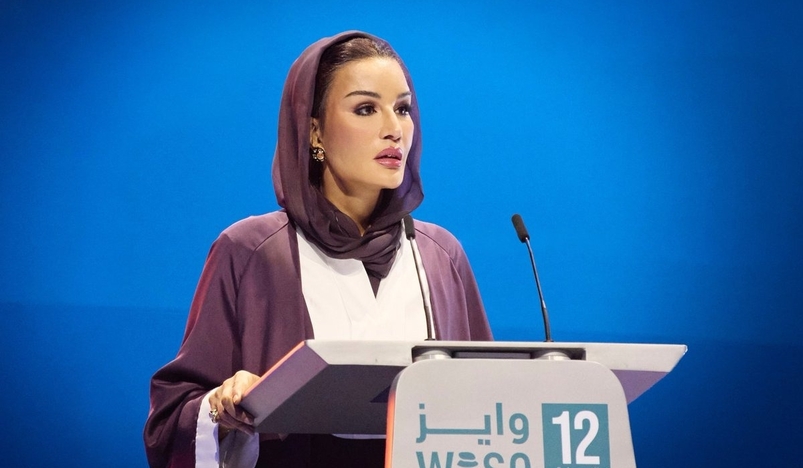
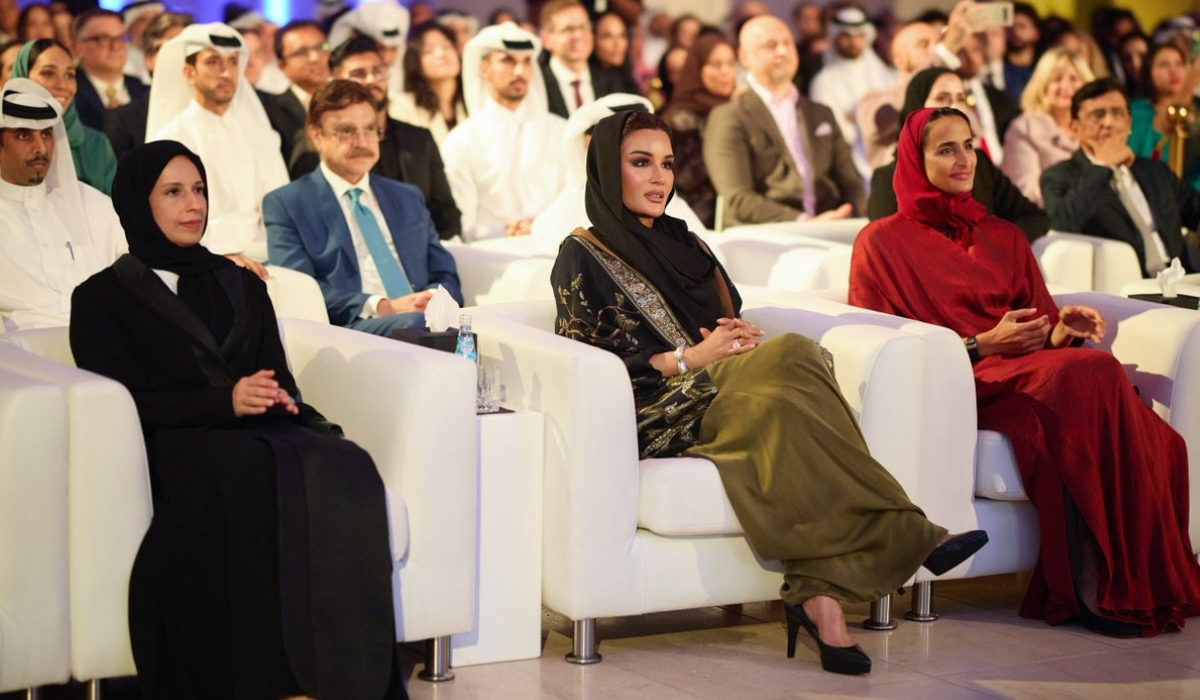
Doha, November 24 (QNA) - HH Sheikha Moza bint Nasser, Chairperson of Qatar Foundation for Education, Science and Community Development, on Monday attended the opening of the 12th edition on the World Innovation Summit for Education (WISE 12).
Under the theme: "Humanity.io: Human Values at the Heart of Education," this edition is being held on November 24 and 25 at the Qatar National Convention Centre, with the participation of a distinguished group of leaders, experts, and innovators from over 150 countries.
The opening ceremony was attended by HE Vice Chairperson of Qatar Foundation for Education, Science and Community Development, Sheikha Hind bint Hamad Al-Thani along with a number of Their Excellencies ministers and heads of diplomatic missions accredited to the State of Qatar.
In her opening remarks, HH Sheikha Moza bint Nasser emphasized that education must remain an open field for creativity and innovation, not a framework for imitation or the rehashing of old questions in new forms. She stressed that the WISE platform was established to be a stimulating space for breaking down traditional molds and encouraging unconventional thinking.
Her Highness pointed out that education is not a service sector like others, but rather an inherent right upon which human dignity, justice, and progress are based. It should not be reduced to a commodity or a privilege granted by one party to another. She explained that the global discourse on education now requires a profound review-one that examines not only achievements but also the obstacles that hinder educational advancement.
Her Highness added that the world today is experiencing a striking knowledge disparity. Humanity no longer functions as a single, unified society but as diverse societies progressing through different stages of knowledge development. This is largely due to the accumulation of institutional and educational imbalances in many countries and regions, particularly in the Arab and African worlds, and parts of Asia and Latin America. She noted the absence of these regions from global platforms of scientific and innovation achievement, except in individual cases often linked to migration to more supportive and stimulating scientific environments.
Her Highness then posed the question: Where does the deficiency lie? Is it within individuals themselves, or within their social and scientific environments? She emphasized that the answer leads to a larger question concerning the conditions for keeping pace, staying abreast, and competing—conditions that necessitate continuous and genuine development of educational curricula, teaching methods, and learning environments.
Her Highness announced that the WISE Summit is about to launch a new index for measuring the quality of education. This index is unique in that it does not merely assess academic performance but also integrates the social and cultural values that form the core of the educational process. She noted that the WISE Awards fall within this framework, supporting initiatives that offer innovative solutions to enhance the quality of education globally.
In reviewing the trajectory of human scientific progress, Her Highness explained that humanity, which has moved from one era to another over thousands of years, now moves from one era to another in just a few decades. This reflects an unprecedented acceleration in knowledge and technology. She pointed out that science, which was the foundation of civilizations and the cornerstone of every scientific transformation, now stands at a new crossroads that surpasses human capacity for comprehension and response, given the tremendous speed of technological advancements.
To illustrate how these disparities intersect with rapid technological change, Her Highness turned to the topic of artificial intelligence explaining that it presents a unique challenge, as it is the first time in history that humans are relinquishing a portion of their intelligence to a machine capable of thinking and making decisions with a speed and efficiency that surpasses their own abilities. She warned of the dangers of expanding AI applications to a level that could infringe upon human freedom and lead to "technological dependency" if not governed by clear ethical principles.
Her Highness emphasized that "science, when divorced from values and ethics," can become a tool serving evil instead of good. She cited weapons of mass destruction, which she considered a "rotten fruit" of science when practiced without ethical responsibility. She pointed out that the scenes of conflict and bloodshed in many parts of the world, including Gaza and Sudan, represent a manifestation of the absence of human conscience and the separation of science from its noble purposes.
Her Highness addressed questions related to the future of education in the age of artificial intelligence, wondering whether the traditional school would survive, whether the university lecture hall would remain unchanged, or whether technological advancements would impose new educational models based on individualized learning rather than collective learning, and whether the educational process would be completely freed from its constraints of time and place.
Her Highness emphasized that these questions do not afford societies the luxury of waiting, but rather demand proactive awareness and a vision capable of developing solutions and shaping the future of education in line with the rapid changes underway.
She added that the world, which today enjoys an abundance of opportunities for a good life thanks to science, simultaneously faces the danger of humanity losing its essence due to the radical transformations that technology may impose, considering this the "greatest paradox" of the knowledge age.
Her Highness concluded her remarks by emphasizing that placing human values at the heart of the education system represents "a restoration of dignity to both science and humanity." She called for an education that promotes the values of truth, justice, and beauty, and for knowledge that serves as a means of liberating humanity, not enslaving it. She wished the summit participants every success.
Through its initiatives and international partnerships, the WISE Summit continues to solidify its position as a global platform that brings together leaders, thinkers, and innovators to discuss the future of education and build more equitable and just educational systems worldwide. Since its inception, the WISE Summit has welcomed over 15,000 participants representing diverse educational and research sectors globally, establishing itself as a leading platform that unites decision-makers and experts to exchange experiences and develop practical solutions to educational challenges.
Source: QNA
.png)

.jpg)
.jpg)
_20-08-2026_05-08.jpg)
_27-51-2026_11-51.png)
_27-43-2026_12-43.png)



.jpg)
.jpg)


.jpg)

.jpg)
.png)
.jpg)










Leave a comment